ROIS
Node instances
ROIS also supports node instances, these can be used to represent a particular instance of a node class. The name of a node instance has the following format [nodeclass: name], e.g. [Person: John]. The inheritance and sanctioning mechanism act the same for node instances as they do for node classes. A major difference between node classes and node instances is that the latter can not have any children.
The existence of data flow graphs connected to a node class has an effect on the initialisation of node instances of that node class. For all relations, where the qualifier is scheme and the cardinality of the link class is manyOne or oneOne, that are inherited by the new node instance a link is created that links the node instance to an instance of the head of the original link. This new link has the qualifier fact and the value of the instance of the head is set to unknown. For example when the model contains the relation Person.hasWeight.scheme.weight and an instance John of Person is created, the link [Person: John].hasWeight.fact.[weight: ?] is created. Inherited relations with the qualifier fact are also copied to the instance, in that case the head of such a link is itself an instance and is just copied. For example when the model contains the relation Person.hasLength.fact.[length: 1.80] the link [Person: John].hasLength.fact.[length:.180] is created for the instance [Person: John].
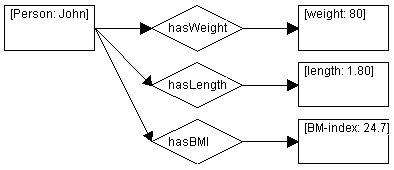
Below an instance of the node class Person from an example data flow graph is shown. In this example it is assumed that the values for the weight and length instances are set by some user interaction. The value for Body-Mass Index is then automatically computed by ROIS, and updated in case the value for either the weight or length changes.